
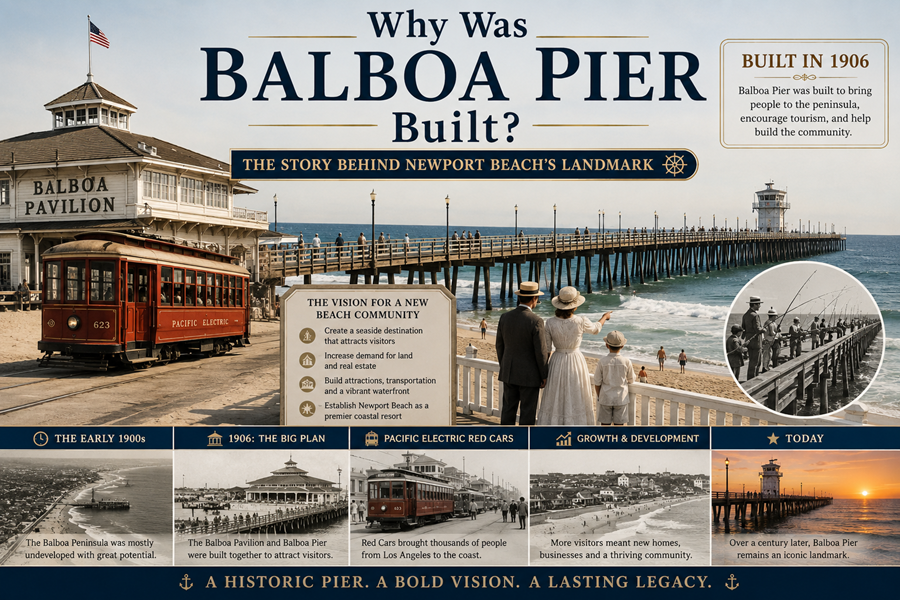
Balboa Pier was built in 1906 as part of an ambitious plan to transform the largely undeveloped Balboa Peninsula into a thriving seaside destination. Rather than constructing the pier solely for fishing, developers saw it as a centerpiece that would attract visitors, encourage tourism, and increase the value of nearby land.
More than a century later, the original vision has proven remarkably successful. Balboa Pier remains one of Newport Beach's most recognizable landmarks and continues to welcome millions of visitors every year.
A Vision for a New Beach Community
At the beginning of the twentieth century, the Balboa Peninsula was little more than a long stretch of sand bordered by the Pacific Ocean and Newport Bay. Developers believed the location had enormous potential but needed attractions that would encourage people to travel there.
The Newport Bay Investment Company decided that creating a modern seaside resort required more than simply selling land. Visitors first needed a reason to come, experience the coastline, and imagine themselves living beside the ocean.
Building the Pier and Pavilion Together
To achieve that goal, construction began on two signature projects in 1906: the Balboa Pavilion and Balboa Pier.
The pavilion became the social and entertainment center of the growing community, while the pier extended into the Pacific Ocean and gave visitors a place to walk, fish, enjoy ocean views, and experience the California coastline.
Together, these landmarks formed the heart of the new Balboa Peninsula.
The Arrival of the Red Cars
The opening of the pier coincided with the extension of the Pacific Electric Railway, commonly known as the Red Cars. The railway connected the Los Angeles area with Newport Beach, making travel to the coast much easier than ever before.
Thousands of visitors arrived by train, walked directly toward the Balboa Pavilion and Pier, and discovered a destination that was rapidly becoming one of Southern California's favorite beach resorts.
Encouraging Land Sales
The primary business objective behind the project was to increase demand for nearby real estate. By creating an attractive waterfront destination, developers encouraged visitors to purchase homesites and invest in the growing beach community.
The strategy proved extremely successful. As more visitors arrived, businesses, hotels, restaurants, and homes began to appear throughout the peninsula.
More Than a Fishing Pier
Although Balboa Pier quickly became a popular fishing location, that was never its only purpose. It also served as a public gathering place where families could stroll along the ocean, watch passing boats, enjoy sunsets, and experience the Pacific coast.
The combination of recreation, tourism, transportation, and real estate development helped establish Newport Beach as one of California's leading coastal destinations.
A Lasting Legacy
More than one hundred years after its construction, Balboa Pier continues to fulfill the purpose for which it was originally built. Visitors still arrive to enjoy the beach, explore the waterfront, photograph the scenery, fish from the pier, and discover the attractions of the Balboa Peninsula.
While Newport Beach has grown dramatically since 1906, the pier remains one of the city's most important historic landmarks and a symbol of its early development.